
- Details
- Category: News
- Published: 21 April 2011
Background info:
Qat is packaged as tufts of leafy twigs, the leaves are chewable. Drug experts note that the effect produced by chewing is similar to cocaine intoxication; however, it often results in lethargy. 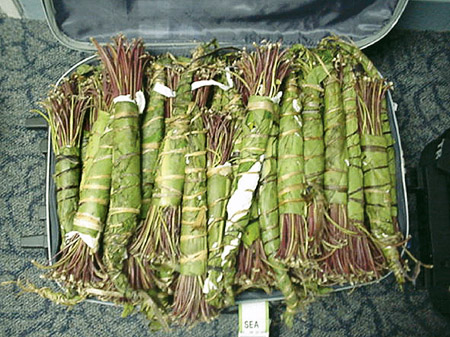
Setting the scene
Like fire-flies they make for it. There is fresh “qat” again. The tiny square in Uithoorn in the vicinity of Amsterdam is flooded by qat customers . They arrive from all over Europe. The Netherlands and Great Britain are the only countries in Europe where qat is a legal drug.
Four times a week a plane lands at Schiphol airport with 20.000 kilograms of fresh qat straight from Kenia. Tens of motor-cars from all corners of the world are waiting to take the consignment to all over Europe. Especially to Somalian communities, who is the largest buyer.
The qat that comes to the Netherlands is often delievered by the northern route via Germany, Denmark and Sweden to Norway. The centre of this route is the Öresund bridge, which runs from Copenhagen in Danmark to Malmö in Sweden.
From Kenia to Schiphol airport in the Netherlands, the drug comes further to Sweden in consignments of 100 kilos in average, 400-500 kilograms at the biggest.
Olle Schmidt, Swedish EU-parliamentarian, appeals to the Dutch authorities:
“Due to the use of qat there are huge problems in Europe. There is poor integration in many communities. Family life is disrupted. Qat users often need € 25 per day, which diminishes the amount of money to be spent on families and house-keeping. Besides, the use of qat is detrimental to health.
I appeal to the inhabitants of the Netherlands to have qat added to the list of the illegal narcotic drugs”.
Qat is an international issue
Qat is a huge problem also in Sweden. Among other places, the outskirts of Rosengård, the suburbs near the city of Malmö, have a big share of Somalian population. They tend to meet regularly in a certain district, were quite a lot of qat is used.
A spokesman of the community, Oman Adam, states:
“We have an Islamic culture, which forbids alcohol. In order to get slightly tipsy, we chew qat. I don’t take it anymore, because I tend to get sleeping problems. Somalian Muslim terror organisation, Al Shabaab, is the fastest growing branch of Al Quida and is only pleased that there is so much qat traffic. Intelligence Services and experts on terrorism are of the opinion that the money gained from drug-trafficking, a roughly estimated 60 to 150 million Euros, disappear in the pockets of Al Shabaab”.
Magnus Ranstorp, Swedish expert on terrorism also thinks that financing Al Shabaab is made possible by qat. The financial track ends in Dubai and the Golf-states. In June a Dutch radio program “This is the day” tracked down two Swedish-Somalian ex-smugglers. One of them explained that he had been smuggling qat twice a week for 3 years. The delivery took place via contact persons in Denmark, Sweden and Norway. He had stopped smuggling when he discovered that Al Shabaab pulled the strings in this business. Al Shabaab forbids the use of qat, but at the same time it makes a lot of money by trafficking the drug.
The Dutch qat problems
30 percent of 22.000 Somalians living in the Netherlands are abusing dole. Dutch Somalians are dependent on social welfare more than any ethnic migration group. In Tilburg, 18 percent of Somalians between 12 and 17 years old are suspected of criminal actions. That is the highest percentage among young foreigners living in the country.
Is there any solution for this problem? A possible way to start tackling problems in the Somalian community would be by prohibiting qat.
On the bright side, a mayor of Tilburg for a while now has been the present minister of Safety and Justice Mr. Ivo Opstelten, who is well informed about qat problems. He is also well-known for his rigorous measures regarding coffee shops and hemp-plants when acting as a mayor of Rotterdam. We certainly hope that minister Opstelten adds qat to the list of the forbidden substances in the Netherlands.
PS:
The mills of justice work slowly. It concerns battle against drugs in the Netherlands.
As early as 1992, in my capacity of a chairman of the society working with drug abuse, I already informed the authorities about qat problem and its free import to the Netherlands in TV-programmes etc.
Already in 1978 I warned about the risks of cannabis use, coffee shops and drug-trafficking in connection to that. Only now does the government take action, rather late, but let’s hope it’s not too late though!
Jan Berlijn, ECAD correspondent in the Netherlands
Noted by Carla Maissan