
- Details
- Category: News

Picture: DELFI.LV
After one death last Thursday and one almost lethal experiment with Spice among 17-year-old students this weekend in Riga, Latvia, hundreds of people protested in the streets against "legal highs".
Latvia is one of the most affected EU countries, as many as 10% of young people in Latvia, Poland and the UK have used new psychoactive substances, with topping 16% in Ireland, according to 2011 Eurobarometer survey.
Young people who miss their friends and classmates, their parents and simply concerned civilians blocked all Spice-trading points in Riga in a protest action on Monday night. Civilians organised themselves as an NGO "Stop Drugs" a while ago and now cooperate with many athletic clubs in the city.
Protests in Riga are caused by abundant small shops in the city and its outskirts, trading with Asian tees or advertising shoe repair and sewing clothes, but in fact selling mixed psychoactive substances, often called "Spice". Whoever passes these small sheds can observe their trading licences for demonstration in the windows. Still, young people would tell that the shops are trading with some "extra stuff", the majority of those who live or study in the nearabouts are well aware of what is being sold. Yet, the police lacks instruments to close the shops as the owners have a legal trade certificate.
Latvian police works hard to find arguments for shutting down the shops with still valid trade certificates and Latvian Minister for Internal Affairs, Mr. Rihard Kozlovsky is apprehensive about the state of a new black market establishing right on the spot. "It could be even more difficult for the police to cope with the situation when the "salesmen" loose their licence and "go underground"", he said.
EU Commission as late as in September 2013 proposed to strengthen EU`s ability to respond to "legal highs", by taking the poisonous substances away from the market as soon as possible.
ECAD takes Riga`s concerns seriously and encourages other member cities to respond to this situation together by initiating a project under the EU auspices in 2014.
- Details
- Category: News
The City of Aprilia adheres to developing prevention initiatives and fostering contacts between local governments and the EU, the UN and other international organizations in order to intensify efforts reducing the spread of drugs, which is the basis of ECAD work.
Aprilia City supports the aims of Stockholm Resolution to protect the health and welfare of individual citizens and families, preventing dependencies arising from drug use.
Welcome to ECAD, Aprilia!

- Details
- Category: News
So this year accordingly, Kristiansand invites you to join policy makers, doctors and youth coordinators for a one-day seminar on February 19, 2014. Discussions on how to work with the youth, new cannabis alternatives on the market and on outsiders of the society will follow.
Download the programme here (PDF)
Webpage in Norwegian: http://hasjavvenning.no/
And some more detailed information in Norwegian:
HASJAVVENNING KRISTIANSAND
I tilknytning til seminaret ”Ut av tåka 2014” inviterer vi dere som arbeider med hasjavvenning i landet til:
ERFARINGSDAG
Tirsdag 19. februar kl. 11-16 på Samsen kulturhus
Pris: kr. 350 inkl. lunsj
Kl. 18.00 – sosial sammenkomst med middag på Håndverkeren restaurant & pub. Deltakere må betale mat og drikke selv (inngår ikke i prisen for erfaringsdagen).
Påmelding: kristiansand.kommune.no/taaka
Hvis du ønsker å holde innlegg denne dagen, ta kontakt med:
Madelene Skårdal, tlf: 90 60 29 64
E-post: This email address is being protected from spambots. You need JavaScript enabled to view it.This email address is being protected from spambots. You need JavaScript enabled to view it.">
This email address is being protected from spambots. You need JavaScript enabled to view it.">
- Details
- Category: News
The purpose of the visit was to learn about Italian "best practice" work in prevention and recovery with a focus on teenagers and young cannabis users. Kicki Winnerstam of Lidingö city in her short programme visited Anglad Rome and Dianova Italia.

The Anglad Rome (National Association of Parents Fighting against Drugs) was founded in 1997 and configured as a non-profit organization with a reference to the San Patrignano experience as a residence treatment center for drug addicts. Anglad Rome helps addicts and their families during rehabilitation and reintegration.
Paolo de Laura, President of Anglad in Rome, organized a specific program for Lidingö study visit, including a live-session with self-help group of parents and a meeting with various experts and professionals working with Anglad.
Dianova Italia is the local branch of Dianova Network, an international NGO in a consultative status with ECOSOC. It operates in 11 countries developing programs for education, youth, addiction prevention and treatment, also in the area of social- and community development.
Dianova Director Massimo Bagnasco and his staff, opened the doors of the residential therapeutic community for adults with alcohol and/or drug addiction in Palombara Sabina (30 km from Rome) to show the visitors Dianova`s science-based and person-oriented approaches. Dr. Bagnasco was also involved in the subsequent visit to Dianova innovative Residential Services for Adolescents, "la Villa".
ECAD invites other cities to join the example of Swedish Lidingö and make use of their membership in practice.
- Details
- Category: News
ECAD in Latvia

Left to right: Andrejs Vilks, Jörgen Svidén, Janina Romanova, Māris Romanosvskis
ECAD has recently visited two of its most active cities in the Baltics, Latvian capital Riga and a smaller resort city of Jurmala. The timeline was right after the municipal elections and political perturbations after these did not allow meeting new mayors. Riga is one of the most active ECAD cities participating in the biggest projects since the grass roots of the organisation, that is why ECAD has its regional office there. Head of ECAD Office in Latvia Andrejs Vilks saw to introduce ECAD guests to the work of several regional sections of Riga Addiction Prevention Centre.
The Centre was unique in the Baltic countries, independent in its research, developing prevention programmes nationally and borrowing international expertise on a wide range of addiction subjects. The Centre is being reorganized at the moment and Riga City Council has lost the prerogative to manage it. The Centre will become a part of state Welfare department and loads of work is to be done to change the routines and curb the bureaucratic paperwork.
Jurmala city with its 53 000 inhabitants joined ECAD in 2007 and since then has been proudly making use of everything ECAD membership has to offer. Jurmala municipal police chief Maris Romanovskis showed the newly renovated and one of the best equipped in the country premises of the police building. Despite Jurmala`s minor importance on the national scale the city boasts very broad sandy beaches that attract not only tourists but also many drug dealers. Jurmala lies in the middle of drug traffic corridor, leading from the harbours of Liepaja and Ventspils in Kurzeme County to Latvian capital city. So during the first 5 months of 2009 Jurmala city police has already registered 33 criminal cases in connection to drugs.
Laima Grobina, chief for Jurmala Social welfare department has told about the challenges of working in socially exposed parts of the city, where low living standards produce other problems. Although city authorities work in tight cooperation with NGOs, lending premises for free and providing Internet services free of charge, a need for new prevention programmes and cooperation with other ECAD cities is of greatest interest.
5 June 2009
Balkan Network News

On 4-5 June, I visited Sozopol in connection with the 6th ECAD Balkan Conference which took place in this Bulgarian city located on the Black Sea coast. The conference was arranged by Burgas municipality (the main city of the province where Sozopol belongs to) and the ECAD Regional office. The Balkan network of ECAD cities is an extensive and active group, led by Dr. Ivaylo Dimitrov, a very engaged person. He is the man behind the ECAD’s advance on the Balkan with the fastest growing number of member cities. During the visit, I had productive discussions with Dr. Loris Manuelyan and Bozhidar Kanchev, both representatives of Burgas municipality and members of ECAD’s Advisory Board. The conference gathered 50 delegates from Bulgaria, Serbia, Romania and Turkey. Intense sessions took turns with open discussions between the participants. Truly, this is the primary task of all activities within ECAD – to assist in making new contacts and strengthening of the old ones. The conference in Sozopol fulfilled this task with excellence.
I regard my visit to Bulgaria as an important step in learning of how the Balkan network works ahead of the coming Mayors’ Conference ECAD arranges in Varna in 2011. - Jörgen Svidén
10 May 2009
Human being in the centre of our policy
Some comments on the Vilnius conference
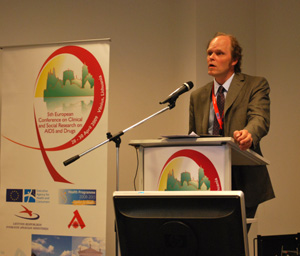
On 28-30 April, a major Conference took place in Vilnius, the 5th European Conference on Clinical and Social Research on AIDS and Drugs. The Conference addressed a vast number of issues - both scientific and practical. Overall it was a very good conference, well organised and with many fruitful lecturers and seminars. I’m sad to say, many of the speakers who talked about ways of preventing abuse of drugs and treatment to abusers seemed to believe that the so called harm reduction-approach is the only answer to all questions. In their mind, harm reduction is a goal, not a tool. I made two speeches at the Conference; one about alternatives to imprisonment and one about ECAD, drugs and AIDS. In the latter I emphasised that we have to move on from this counter productive debate on policies and start to focus on good role models and well proved experiences on how to deal with a problem we all want to find solutions to. Diversity is positive for the sake and something to defend, but when it comes to illicit drugs, it often ends up in an unbalanced picture; either you are pro harm reduction as the only solution or you are against. If you are against you are an enemy. To me, this is very tiring. We do not have to love what others do but we have to accept their manner, as long as it aims at reducing illegal drugs in the society. I stressed that the ECAD member cities support a restrictive policy, combined with humanity and a holistic approach, as the most appropriate way to prevent people from being addicted to drugs in the first place and to help abusers to find way out of their situation.
Jörgen Svidén
April 28-30, 2009
ECAD supports and participates in the 5th European Conference on Clinical and Social Research on AIDS and Drugs on April 28-30, in Vilnius. The Conference will address a vast number of issues - both scientific and practical, you can have a programme overview here. We publish two short abstracts of the Conference addresses that ECAD will present in Vilnius.
ECAD director Jörgen Svidén will speak on ECAD, Drugs and AIDS:
"There are tight connections between drug abuse and HIV/AIDS and that we have to tolerate that people have different approaches towards the problem we all want to find solutions to.
In the work against drugs and the problems that drugs cause – we can and must accept that policy makers and decision makers choose different methods. As long as they are in accordance to the UN Conventions it is not a problem. A successful policy is built on a holistic perspective and a balanced approach. I strongly believe that a restrictive policy, combined with humanity and with a holistic approach, is the most appropriate way to prevent people being addicted to drugs and infected with HIV. In a restrictive and humane society you will see fewer addicts and the ones who are addicted or infected will be offered help, not punishment. In fact, if you look at a map you will discover that in the areas where you have less restrictive view on drugs, you will find more people infected with HIV/AIDS. The so called harm reduction measures can never be a goal in it selves, but they can – if one must use the phrase, be a tool".
Jörgen Svidén will also refer to the issue of Alternatives to imprisonment:
"Imprisonment should not be taken for granted as a natural form of punishment for drug offenders as that have shown to be counterproductive in the rehabilitation and reintegration of this group of people and these measures are far more expensive than most alternatives. The vast majority of the imprisoned population is drug addicts and there is a number of evidence based alternatives to help these people more effectively and less expensively. If we really want to change behaviour and reduce crime, improve health, social well-being and minimize costs for the society, we should prefer alternatives that benefit not only one individual drug user but society as a whole".
ECAD in March 2009

This month has been exceptionally rich in events for all conscious drug policy makers in the world as well as for NGOs and ECAD.
Here is a short overview of the hectic work schedule we have at ECAD this month:
- March 17, 2009: ECAD network of Swedish cities meet for planning and working discussions at ECAD Head Office.
- March 16-17, 2009: Study visit to St. Petersburg, Russia. ECAD cities for efficient drug policy that works! ECAD director Jörgen Svidén makes a study visit to our partners and colleagues working at St. Petersburg Legislative Assembly and State Anti-drug Committee of St. Petersburg (GAK), led by the governor V.I. Matvienko. After that, ECAD director meets with the dean of the Conflictology Department at St.Petersburg State University Alexander Strebkov, ECAD Regional Office director George Zazulin and his assistant Artyom Sunami.
- March 12, 2009: 10th Anniversary of ICSRA, Reykjavik. ECAD Director, Jörgen Svidén visits the 10-year anniversary of the Icelandic Centre for Social Research and Analysis/Reykjavik University, acknowledging and supporting their work. Among the honourable guests of the event is H.E. Olafur Ragnar Grimsson, President of Iceland and the Patron of ECAD largest prevention programme Youth in Europe. ICSRA works with primary prevention, without ever mentioning drugs.
- March 11-20, 2009: United Nations Commission on Narcotic Drugs opens its 52 Session and holds High Level Segment meeting reviewing the effectiveness of drug control. ECAD is a member of Vienna NGO Committee and was invited to the meeting in Vienna. ECAD Assoc. Director Mr. Åke Setréus takes part in the round table discussions along with over 1 400 participants, coming to Vienna from 130 countries.
- March 3-4, 2009: European Commission organizes a Civil Society Forum on Drugs in Brussels. ECAD director Jörgen Svidén visits the Forum to take part.
January 2009
Second World Mayors' Conference on Drugs
“Cities have the drug problems of their choice.”
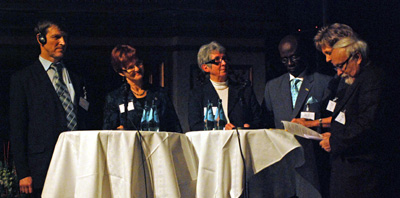
From left: Mikhail Korzhik, St. Petersburg; Aud Kvalbein, Oslo; Maj Steen, Borås;
Desmond McKenzie, Kingston; Trude H. Drevland, Bergen; Marcel Neven, Visé
On February 5-6 Göteborg hosted the Second World Mayors' Conference on Drugs which was held together with the 16th ECAD Mayors’ Conference. Over 230 participants representing 66 cities in 29 countries took part in this global manifestation in support for humane, restrictive drug policies based on the United Nations Conventions on Drugs. Year 2009 marks the 100th anniversary since the first international opium commission in Shanghai, China, brought up on the international agenda the issue of devastating consequences caused to individuals and societies by opium trade and abuse of this drug. Three years later, the first international opium convention was adopted in the Haag. By 1925 not only opium but also cannabis and cocaine were included in the international treaties thereby creating a legal framework for drug control in a modern form.
Antonio Maria Costa, the Executive Director of the UN Office on Drugs and Crime, reviewed for the conference delegates the effects of drug control system. He emphasized that it is due to the development of the international drug control we can now define the global situation as “contained”: “the world drug problem can no longer be assimilated to the run-away train of the early 1900s (namely before Shanghai), or to the late 1990s (namely before the UN General Assembly Special session of 1998) when drugs were – or they appeared to be – an uncontrolled and uncontrollable problem.”
The conference programme presented a balanced combination of global and local perspectives. Antonio Maria Costa and Jan Eliasson, former Swedish Minister for Foreign Affairs stood for the global view while local reports were delivered by speakers from a number of great world cities such as Nelson Mandela Bay in South Africa; Hanoi in Vietnam; San Ramón in Costa Rica; Washington in USA; Moscow in Russia; Bari in Italy and the host city. The mayor and chairman of the Göteborg Executive Board Anneli Hulthén was strong in her performance and clear in the message to the worlds’ mayors, stating that “drugs have no place in our society”. Göteborg regards the consequent, restrictive drug policy based on the UN conventions as a vital ingredient for the sustainable development of a modern city.
The Conference concluded adopting a Declaration to be presented to the 52nd Session of the Commission on Narcotic Drugs which will take place in Vienna in March. This Declaration signed by the World Mayors’ Conference is aimed to show yet another section of the world community – municipalities – united behind the UN drug control system. At the same time, the Declaration reinforces our own engagement in tackling the drug issues in a sustainable way. ECAD expresses its gratitude to the city of Göteborg for great organisation of the conference and for the inspiration of the Göteborg’s engagement in drug issues that the delegates could take home.
2 February 2009
Press Release from ECAD
World Mayors: We Stand Behind UN Conventions on Drugs
Conference in support for UN Conventions on Drugs ahead of UN Strategic Drug Policy Review

In 2009 it will be 100 years since the first international conference in Shanghai, China, which lead to development of an international drug control system. Today, it is the three United Nations Conventions on narcotic drugs which regulate the international drug control. These conventions are presently under considerable pressure from drug liberal forces around the world.
During February 5-6, 2009 the City of Göteborg hosts the World Mayors’ Conference on Drugs. Participation is estimated to over 200 representatives from such cities as Moscow, San Ramón, Nelson Mandela Bay (Port Elizabeth), Bari and other bigger and smaller world cities; non-governmental organisations, government representatives and researches. The conference has two purposes: to declare the full support of the UN Conventions on Drugs and to strengthen, through international co-operation and exchange, the work against the abuse of illicit drugs.
The Second World Mayors’ Conference is held together with the 16th ECAD Mayors’ Conference. ECAD stands for humane, restrictive anti-drug policy rooted in prevention, treatment, research, and law enforcement. ECAD member cities work to develop initiatives and efforts against drug abuse supporting the UN Conventions which oppose legalisation of presently illicit drugs. The issue of maintaining restrictive and humane drug policies, both nationally and internationally, is on top of the political agenda in 2009. Conference is taking place a month ahead of the Fifty-second session of the Commission on Narcotic Drugs. At the conference, mayors who represent millions of world citizens will raise their voice in support for international goals against drug abuse, says Jörgen Svidén, ECAD Director. The Conference will also become a starting shoot for the City of Göteborg to focus, during 2009, a special attention on work against drug abuse and its consequences for the community, says Jörgen Linder, Lord Mayor of Göteborg.
The Conference is under the Patronage of H.M. Queen Silvia of Sweden. Among the key-note speakers is Antonio Maria Costa, UN's highest official for drug control. Other speakers include Hon. Raúl Antonio Gómez Guerrero, Mayor of the city of San Ramón, Costa Rica (EU LAC Initiative - the Initiative of European Union and Latin America and Caribbean Strategic Partnership); Cllr. Nondumiso Maphazi, Hon. Executive Mayor, Nelson Mandela Bay Metropolitan Municipality (Port Elizabeth), South Africa; Ambassador Jan Eliasson - until July 1, 2008 Special Envoy of the United Nations Secretary-General for Darfur; President of the 60th session of the United Nations General Assembly 2005-2006; Sweden's Ambassador to the United States, 2000-2005; Minister for Foreign Affairs of Sweden in 2006.Contact person Jörgen Svidén Director ECAD This email address is being protected from spambots. You need JavaScript enabled to view it.
Download Press Release as PDF-file here
9 January 2009
ECAD Norway – network’s meeting

The Network ECAD Norway gathered in Trondheim on January 9, 2009 for discussions about, among other things, future engagement in the ECAD work. Twenty representatives of Trondheim, Oslo, Stavanger, Bergen, Kristiansand and Drammen took part in the meeting. Researcher Tormod Öia opened the day’s discussions by presenting results of the survey on drugs among 15-16-year olds in Oslo which is a part of the ECAD’s ‘Youth in Europe’ programme. A lecture on medical treatment was followed by a debate about the Norwegian government proposal to introduce drug injection rooms resp. legal prescription of heroin. The delegates agreed that this was undesirable development and a number of solid arguments against injection rooms and legal prescription were brought forward.
The day was wound up with ECAD Director Jörgen Svidén’s account of the today’s ECAD work. He pointed out that ECAD strives to a higher degree than today to be a knowledge organisation, with one of the main tasks being to disseminate examples of best practice and successful methods to the members. The cities have both a lack of knowledge in the drug-related issues and a thirst for knowledge, and ECAD is aimed to bridge this gap - there is no other organisation in Europe directly addressing these issues. Jörgen Svidén emphasised further that ECAD in the future has no intention to condemn different methods to tackle drug problems, which some of the Norwegian cities have experienced. What unites the cities in ECAD is their determination to strive at a drug free society, and in this regard different methods deserve to be met with respect. The Norwegian delegates have expressed their unanimous support to this view on ECAD’s work.
10 October 2008
ECAD Advisory Board met in Cork

ECAD Advisory Board had its autumn meeting last week in Cork, Ireland. Representatives of Istanbul, Warsaw, Burgas and Göteborg including ECAD staff met with Lord Mayor of Cork, Councillor Brian Bermingham. Despite scarce attendance the meeting resulted in productive discussions about the future of ECAD. ECAD new director Jörgen Svidén pointed out that ECAD in transition should become an "opinion-to-knowledge" organisation. “We deliver knowledge today already, but we can do better than that, we can be a bridge from knowledge to action”.
A lot of debating was focused on effective evidence-based drug policies and networking with ECAD member cities. ECAD networking is utterly important. Over the next couple of months we are going to make contact with member cities and ask them what ECAD can do for them. With their feedback we will be able to assess our work. ECAD and the City of Göteborg are preparing ECAD 16th Mayors` Conference - second conference for World Mayors. Göteborg Municipality representatives, Ove Lundgren and Kristina Jung shared with the AB members that their municipality established a steering group that consists of city politicians and a working group to make the Conference preparation process most effective. You can find all information about the conference under Conferences in the menu to the left or at Göteborg municipal homepage if you click here. The conference will have its own website very soon. ECAD is very grateful to Cork City Council for its generous hospitality.
Many interested in Cork outskirts visited Butter Museum and the magnificent Blarney Castle. Those who kissed the Blarney stone will from now on be able to distinguish between “Blarney” and “baloney”. Next AB meeting will take place in Göteborg, 4th of February 2009 in the afternoon in connection with ECAD World’s Mayors Conference that takes place on February 5 and 6, 2009.
2 - 3 October 2008
ECAD Sweden held Annual conference in Umeå
ECAD Swedish network had an annual conference: ”Norrland, a drug-free region?” during 2 and 3 of October in Umeå.
The Conference was opened by Mrs. Eva Andresson, a head of Social Committee in the City of Umeå. She welcomed more than 60 drug coordinators and representatives of 17 Swedish municipalities to the conference. Umeå is one of six project municipalities (also Kalmar, Kramfors, Laholm, Lund and Solna) that were a part of Swedish national prevention plan for alcohol and drug-related problems. The aim of the project, which started in 2003 was to assist the municipalities in developing long-term prevention measures using evidence-based methods.
This long-term work implied 10 million Swedish crownes invested annually in primary and secondary prevention for Umeå municipality. The prinicipal idea was also that it should be easy to get treatment and hard to use drugs.Carina Dahl, head of ECAD Sweden, Örebro presented a winner for ECAD Sweden Annual achievement, this year it was Cina Persman and Christer Lundsten, school supersivors in Örebro municipality. Cina and Christer started probing local drug- and alcohol use grounds at school as early as 2001. That was done in order to determine a pattern for alcohol and drug use among students. ”It started with an additional education course about drug abuse for all shool staff, including IT-personnel and headmaster. It turned into a close cooperation between social services, gymnasium, parents and students", said Christer Lundsten. A marvellous diptych - the prize for the winner - is a generous present to ECAD from the municipality of Staffanstorp.
A new book that offers an up-to-date review of the prevention literature in the drug field "Drugs in Sweden: Methods of prevention" was presented at the conference. The target group for this book is primarily decision-makers and public servants on local, regional and national levels, but also preventive practitioners, drug coordinators, youth leaders, students and mass media. The book will be published towards the end of 2008, but introduction and summary are available in English today.
Click here to read Introduction and Summary in English, look for the pages 322-349.
In connection to the conference ECAD Sweden held its Board meeting on the 3-d of October.
24 September 2008
George Zazulin, ECAD Director in Russia at WFAD Closing Session:
Securing a drug-free society should become a profession!
Dear friends, colleagues and partners,
Our efforts have resulted in a seemingly insignificant single sheet of paper. However, this paper is our mighty weapon. Someone might ask: why have we been working here for three days if there are UN conventions on drugs? The reason for this is that without leaders and public support these conventions are solely formal papers. You can abide by these documents, but you can also ignore them as it often happens today. People who are present today at the Forum do not only acknowledge the norms of the conventions, they also understand the spirit and value of the documents they protect.
We must realize that securing a drug-free society should become a separate professional branch, especially on political and managerial levels. This is our goal that ECAD in Russia has been pursuing for the last 5 years. Yesterday we have seen a wonderful dog show: trained dogs helping customs officers in discovering hidden drugs. This work is extremely important. Unfortunately, these anti-drug dogs cannot balance out drug liberal individuals. The latter often have high positions in their field of work (medicine, sociology, law or economics) and should be counterpoised by highly educated specialists on the restrictive side. That is why it is vital that we have profoundly educated professionals, who get their degrees at the best universities of our countries.
Today it is universally acknowledged that there is a lack of professional programmes preparing future drug policy makers or scientists who can work as drug coordinators on all administrative levels. It is our biggest unresolved problem, as I see it. I have invested 20 years to complete my anti-drug education – that is how long I have been working on this issue. Young people do not have to waste 20 years to learn all I know today. By now my colleagues and I offer Master students a lion share of the knowledge we have in two years of Master of drug conflictology programme. I hope that this forum will become the first step in solving the problem of shortage of professionally educated drug policy coordinators in educational institutions of your country. In conclusion I would like to thank the organizers of this Forum, which takes place in the anti-drug capital of Europe – in Stockholm, for all their work. I wish you all success in this noble work and let us meet again!
15 September 2008
Start of a new Global Network Against Drugs
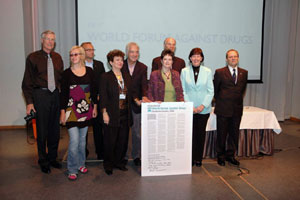
Signatories of the WFAD Declaration, Organisations
The first ever World Forum Against Drugs was held in Stockholm, Sweden, from September 8th through the 10th. This global forum is the first of its kind at which NGOs, self-help groups, treatment centers, academics, municipal and regional authorities, politicians and other decision-makers, private individuals, the business community and others from around the world have got the opportunity meet to express ideas and share experiences about how to work successfully against illicit drugs. Eleven Swedish national organisations and co-partners have taken the initiative to organise this forum. Their first goal was to reach out around the globe, especially the grass-roots NGOs that are working hard to reduce drug abuse and illicit drugs trafficking. As a result of their efforts, more than 80 countries from 5 continents were represented at the 1st World Forum Against Drugs.
One of the explanations for this overwhelmingly positive response is the great need for an active community of people committed to effective drug abuse prevention. Another important goal of the World Forum Against Drug was to send a message to the upcoming UNGASS (March 2009) on narcotic drugs that there is strong popular support from around the world for the UN Conventions on Narcotic Drugs. As the participants of the Forum have expressed it, the central issue of drug policy today is either the world accepts growing illegal drug use or the world continues to work to stop illegal drug use and trafficking. The Forum declared that ‘the proper goal of drug prevention is to stop illegal drug use; not to tolerate it.’
The first World Forum Against Drugs ended in the closing session by launching a global, active and ongoing network of organisations united behind the UN Conventions on Narcotic Drugs. One of the tasks for this new global network will be to organise a series of future world conferences against drug use and trafficking. Sven-Olov Carlsson, representative of the Swedish umbrella organization ‘NGOs against drugs’, said at the closing session, “Human rights are incompatible with drug abuse. All individuals have the right to a life that is not harmed by drugs. Policy-makers need to defend and protect this right. The rights and interests of drug users are not served by supporting the continuation of drug abuse.” World Forum Against Drugs is a non-political movement; its only aim is to work for the vision of a drug free world, and to protect the human rights of drug prevention.
Read the Declaration at www.wfad08.org
June-July 2008
ECAD study visit to St.Petersburg
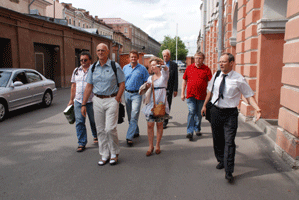
Towards the end of June a group of Swedish drug policy coordinators from 5 municipalities have travelled to St.Petersburg for a few days.
As a part of ECAD education programme 8 Swedes visited International Anti-Drug Policy Centre, national anti-drug policy Committee in St.Petersburg Municipality, Narcology hospital and the eldest in the city Rehabilitation Centre "New Life".
Click here to have a look at the travel story in pictures.
3 June 2008
15th ECAD Mayors' Conference in Warsaw

The 15th ECAD Mayors' Conference was hosted by the City of Warsaw on May 28-29, 2008. ECAD is satisfied with the high number of delegates, including representatives of the host city. The study visits have also been of great interest for the participants. Conference materials and a photo gallery will soon be available on this homesite under Conference papers in the menu to the left. Participants lists are available through the Stockholm office at This email address is being protected from spambots. You need JavaScript enabled to view it.">This email address is being protected from spambots. You need JavaScript enabled to view it.
This email address is being protected from spambots. You need JavaScript enabled to view it.">June 2008
"Dare to be brave"
Interview with Tomas Hallberg, ECAD Director 1999-2008
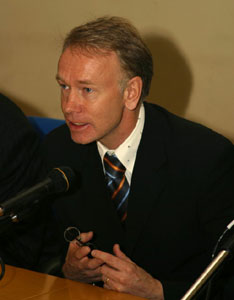
Tomas Hallberg has left ECAD to continue his career within IKEA in Russia. The ECAD Newsletter asked Tomas to look back at his time in the organisation.
EN: Tomas, you came to ECAD in 1999. What did the drug situation look like then compare to what it looks like now?
TH: Drug situation looks differently in different countries. Sweden, for example, experienced a real shake-up in regard to drugs issues, with the help of ECAD’s network and the National Drug Coordinator “Mobilisation Against Drugs”. The Baltic States improved their work against drugs by setting up regular drug enforcement. The same is true for Russia. Among those countries which did not have a positive development, rather the contrary, I would mention England, Scotland and North Ireland. There were no visible changes in Central Europe. Drug problems there remain at the same, rather high level.
EN: Does ECAD face new challenges today?
TH: I believe that the biggest challenge for ECAD as an organisation is to continue to play a prominent role on the international drug political scene. During these years ECAD succeeded to become a known actor. We should be content with the fact that we are respected by both the EU institutions and the UN bodies.
EN: What else does make you feel satisfied when you look back at the ECAD’s development during your years as a director?
TH: I think that one of the most positive outcomes is the networking activities. There is a group of people gathered around ECAD as an organisation which is growing stronger. There are well-functioning competent networks of cities in Sweden and Russia. I am also satisfied with efforts that our organisation made in the field of education. I mean primarily in Russia, where ECAD played an important role in designing of an educational programme for drug coordinators. Our educational model was copied in Italy, which is very positive. I believe that the so far largest ECAD programme Youth in Europe will become leading within its field in future. I am proud that I helped to form and develop these initiatives.
EN: What does worry you in regard to the organisation’s future?
TH: What worries me most is huge resources which the pharmaceutical industry puts into medicalisation of the drug issue which I believe would be a big mistake. The drug issue is first of all a social problem that should be solved by social measures.
EN: Has ECAD competence to discuss such subjects and to counteract such tendencies?
TH: There are many knowledgeable people around ECAD, in our member cities and networks. If we could unite their efforts, there would absolutely be a possibility to counteract such a tendency.
EN: Tomas, what do you wish ECAD?
TH: I wish ECAD as they say in Russia every success and good luck. I hope that ECAD will be brave to defend the old. One needs to be brave to see that what was thought in 1993-19994 is valid in 2008-2009. Drug policy has historically followed swings of the pendulum. It has either been more restrictive or more liberal. Every time it was restrictive there was less problems. When it turned towards the liberal, then there were more problems. That is why one should dare to be brave to even up these swings and stand up for what one believes in.
EN: Thank you.
ECAD Advisory Board has appointed a new director who will lead the everyday organisational life with the start in August 2008.
Subcategories
The ECAD Mayors' Conference
28th Mayor's Conference - Invitation - May 11th and 12th, 2023 - Malta
On May 11th and 12th, the 28th ECADs Mayor's Conference will take place at Dolmen Hotel in Qwara, Malta. We warmly invite you to join us and expand your knowledge on prevention, treatment, rehabilitation and recovery. The conference will highlight best practices and research in the field. It will offer the opportunity to network with other ECAD members, representatives from local authorities, and non-governmental organisations. Registration is free for the first person attending from your organisation!
Additionally, the conference allows for a unique experience as it includes a full day of field visits on May 12th. All participants are invited to Komunita’ Santa Marija, which will be sharing information on their services, and their experiences, and will engage in discussions.
The Agenda has now been published! The deadline to register is April 22nd
Day 1
DATE | TIME | VENUE
11/05/2023 | 09:00 – 17:30 | The Oracle Conference Centre - Dolmen Hotel Qawra, St. Paul's Bay
08:30hrs – 09:00hrs| Registrations
09:00hrs – 09:05hrs| Welcome Address by the President of Local Councils’ Association - Mr Mario Fava
09:05hrs – 09:15hrs| Welcome Address by ECADs Chairman of the Board from Kristiansand, Norway - Mr Viggo Lütcherath
09:15hrs – 09:20hrs| Welcome Address by the Parliamentary Secretary for Local Government - Hon. Alison Zerafa Civelli
09:20hrs – 09:40hrs| Inspirational speech – “Push yourself to do it because no one else is going to do it for you” by the President Northern Regional Council & LCA Executive Member - Mr. Clifford Galea Vella Maslennikov
09:40hrs – 10:30hrs| Panel Discussion and Presentation – Discussing the Local Context
The prevention team within Sedqa would like to present the following studies.
Study 1: The Role of a Workplace Policy in Addressing Employees’ Substance Misuse Difficulties.
Aim: To explore the probability of an employee seeking support for a substance misuse difficulty elicited by the workplace ethic fostered by management. Through this paper, we seek to determine a possible correlation between the implementation of a substance misuse policy at the workplace, and employees’ probability to seek guidance and support from their employers for a substance misuse-related difficulty.
Study 2: A Substance Misuse Policy in the Workplace: Senior Leadership Teams’ Attitudes
Aim: To explore how senior leadership teams’ (SLTs) attitudes inform the drafting of a substance misuse policy and how those attitudes inform job retention procedures in the case of an employee disclosing a substance misuse difficulty. Uncovering SLTs’ attitudes toward addiction is essential to understand how these beliefs inform workplace policy aims and actions on substance misuse.
Keynote speakers representing Sedqa Prevention team:
Mr Jareth Grima – Social Worker
Ms Sheryl Spiteri – Prevention Team
Ms Stephanie Mizzi Cascun – Prevention Professional.
10:30hrs – 11:00hrs| Coffee Break
11:00hrs – 11:45hrs| Mr Jon Sigfússon Planet Youth – Evidence-based drug prevention.
Mr Sigfússon is the international programme director for the evidence-based Planet Youth Guidance primary community-based health promotion intervention. Over the course of 20 years, Mr Sigfússon directed the Icelandic Centre for Social Research and Analysis (ICSRA).
11:45hrs – 12:30hrs| Mr Matej Košir - Strategies and tactics to prevent cannabis legalisation in Slovenia - The power of prevention science and advocacy.
Mr Matej Košir has been working in prevention and advocacy in the field of alcohol, tobacco, and other drugs for around 25 years. Since 2006, he has been involved in more than 30 European projects in the fields of health, justice, education, youth and research as a project or work package leader.
12:00hrs – 14:00hrs| Seated Buffet Lunch
14:00hrs – 14:45hrs| Profs. Christian Thurstone, MD - The impact of legalisation in Colorado, USA – challenges faced by [local] authorities and communities.
Profs. Thurstone is a professor of psychiatry at the University of Colorado and a child psychiatrist who specialises in addiction treatment. He published some of the first papers on the potential effects of marijuana legalisation on youth and has devoted his professional life to preventing and treating adolescent substance misuse.
14:45hrs - 15:30hrs| Ms Mulka Nisic - Recovery Cities - Creating sustainable connections and networks in cities.
Ms Mulka Nisic has been involved as a Regional Project Manager and International Relations Officer at the NGO Celebrate Recovery, and Secretary General of the Recovered Users Network-RUN.
15:30hrs - 16:00hrs| Conclusive Remarks
16:00hrs – 17:30hrs| ECAD Plenary for ECAD Members only
19:30hrs – 23:00hrs| Welcome Dinner at The Pavilion Suite, Westin Dragonara St Julian’s - Separate Registration is required in the application form.
Day 2
DATE | TIME
12/05/2023 | 09:15 – 19:00
09:15hrs – 09:30hrs| Transport leaves from Dolmen Hotel & Salini Resort to Komunita Santa Marija
09:30hrs – 09:45hrs| Registration and Welcome Coffee
09:45hrs – 10:15hrs| Introduction to the services offered by Komunita’ Santa Marija.
10:15hrs – 11:00hrs| Sharing of good practices and discussion
11:00hrs – 11:30hrs| Tour around Komunita’ Sanata Marija premises
11:30hrs – 12:00hrs| Transport to Ħagar Qim in Qrendi
12:00hrs – 13:15hrs| Ħagar Qim Visit
13:15hrs – 13:30hrs| Transport to Xgħajra
13:30hrs – 16:00hrs| Lunch (you will have time for a short stroll by the seaside)
16:00hrs – 18:00hrs| Cultural Visit in Mdina – Visiting the National Museum of National History
18:00hrs – 19:30hrs| Visiting Dingli Cliffs
19:30hrs - 15:30hrs| Transport to Salini Resort and Dolmen Hotel
27th Mayors Conference - Gothenburg and online 2022
The 27th Mayors' Conference and 8th World Forum took place in Gothenburg and online 13-14th June 2022.
The World Forum and Mayor’s Conference is a meeting place for people from all continents who are working to prevent drug abuse, ensure evidence-based and gender-sensitive practices, increase access to treatment, and to promote recovery and reintegration services. This global forum is one of its kind where NGOs, self-help groups, treatment centres, scholars, local, regional, and national authorities, politicians and other decision-makers, and others from around the world will meet to share evidence and best practice experiences. This year’s World Forum will include three main tracks: Prevention, Treatment/Recovery, and Advocacy, which will stretch over 1,5 days followed by the WFAD Congress and ECAD Mayors plenary session.
We are proud to announce that the Forum was inaugurated by UNODC Executive Director Ghada Waly and will be joined by experts from around the world.
Read more on the website: https://2022.wfad.se/ and access the full report here. 
26th Mayors Conference - Cork 2019 
25th MAYORS´ CONFERENCE
and 6th World Forum Against Drugs 
Conference materials
Kevin Sabet, PhD, Director, Drug Policy Institute, University of Florida, President, Smart Approaches to Marijuana (SAM), USA
Speech at the WFAD /ECAD 25th Mayors Conference, Gothenburg, May 15, 2018 (Video 5min.)
Supply reduction in Peril? A lot of the worlds`s drug supply emanates from a war-torn Columbia.
Dr. Michael Jonsson, FOI, Swedish Defence Research Agency
Text to the slides (PDF)
In Columbia, a peace deal has been struck, which gives hope for a closure of insurgency and violence. (PDF)
Thomas Pietschmann, Dr, Drug Research Section, Division for Policy Analysis and Public Affairs
The International drug control system, global/regional and national drug patterns and trends, and supply reduction efforts at the international level (PDF)

Photo: Götaplatsen @ Klas Eriksson
Annual Mayors` Conference and the 6th World Forum Against Drugs will take off on May 14-15 in Gothenburg this year.
This joint event will address a growing interest to the effective prevention practices, full recovery and alternatives to incarceration and to life-long dependency on drug treatment.
The conference will create a room for elaborating a practical guide to how a recovery city will look like, this will be grounded on the recent evidence-based research. Sheffield Hallam University (UK), Ghent University (Belgium) and the City of Gothenburg have already started working on this guide in practice.
In order to find out more and to register please visit a joint webpage here.


MAYORS` CONFERENCE 2017

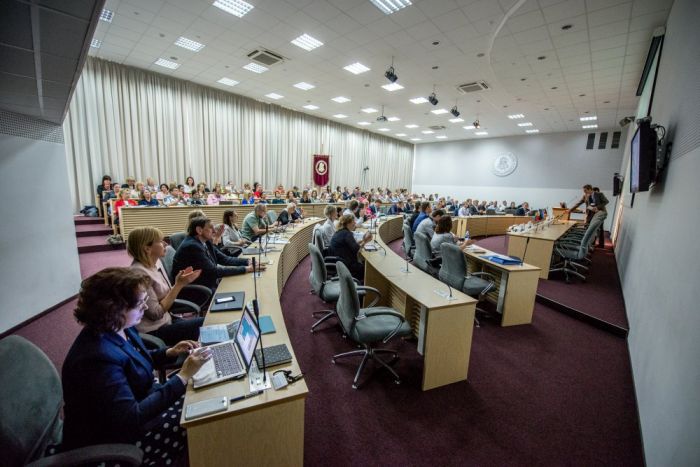
ECAD 24th Mayors` Conference materials
On June 12-13, the city of Kaunas hosted ECAD 24th Annual Mayors`s Conference 2017
Safe Cities Without Drugs. Preventing, Protecting, Policing
Key-note speakers:
David W. Spencer, Field intelligence Manager, Drug Enforcement Agency, European Region
Supply reduction and dismantling drug trafficking organizations: In what ways can local communities benefit (PDF)
Kim Nilvall, Swedish National Bureau of Investigation, Intelligence section, Organized crime
Police work in socially disadvantaged areas in Sweden: Impact of drugs on urban crime (PDF)
Torsten Stodiek, Deputy Head, Strategic Police Matters Unit, Community Policing Advisor, Transnational Threats Department, OSCE
Preventing terrorism and countering violent extremism and radicalisation that lead to terrorism:
A community and intelligence led policing approach (PDF)
Jon Sigfusson, Director for Icelandic Centre of Social Research and Analysis, Reykjavik University, ICSRA
Youth in Europe and Planet Youth (PDF)
Laimonas Vasiliauskas, Senior Specialist, Serious and Organized Crime Department, EUROPOL
European Illicit Drug Market (PDF)
Antonio Boscini, Health Director, San Patrignano Community, Rimini, Italy
Recovery and social reinsertion: San Patrignano Community model extended (PDF)

CONFERENCE PROGRAMME (PDF)
FIRST ANNOUNCEMENT (PDF)
Conference Booking Form

Kaunas Castle
Picture: @Rokas Tenys
Warm welcome to Kaunas, Lithuania!